Watercolor Leaves Seamless Digital Paper: A Practical Guide to Selection and Application
The digital design landscape has shifted significantly toward assets that blend organic aesthetics with technical precision. Among the most sought-after resources for creatives, scrapbookers, and stationery designers is watercolor leaves seamless digital paper. This specific category of digital asset offers a unique intersection of artistic fluidity and functional utility. Unlike standard vector graphics or rigid clipart, these papers provide a textured, hand-painted backdrop that mimics the delicate nature of botanical art while maintaining the structural integrity required for professional printing.
When evaluating a collection such as one featuring 40 distinct variations—ranging from lily and lotus leaves to maple and eucalyptus—the decision-making process moves beyond simple visual appeal. It becomes a question of workflow efficiency, print quality, and versatility. The following analysis explores what makes this format distinct, how it compares to alternative design methods, and the specific scenarios where investing in high-resolution seamless patterns yields the best results.
Understanding the Distinct Nature of Seamless Watercolor Patterns
At its core, watercolor leaves seamless digital paper differs fundamentally from traditional watercolor illustrations. Traditional paintings are finite; they have edges and borders. In contrast, a seamless pattern is engineered to tile infinitely without visible breaks. This characteristic transforms a single image into an endless background resource. For a designer creating a wedding invitation suite, a blog header, or a journal cover, this means the ability to fill large areas with a consistent, flowing texture that feels organic rather than repetitive.
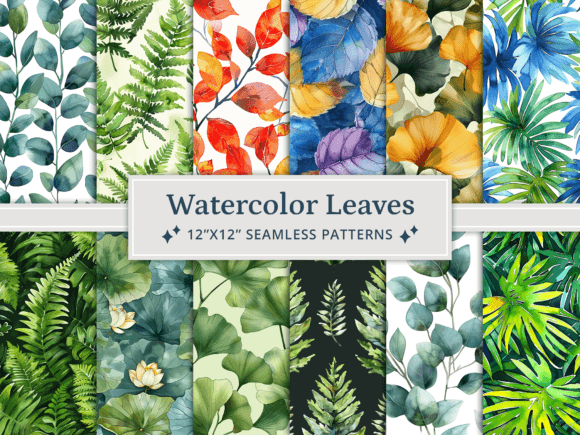
The distinct value proposition lies in the combination of medium and format. The "watercolor" aspect provides soft edges, translucent layers, and natural color bleeding that mimics real pigment on paper. The "seamless" aspect ensures that this artistic style can be scaled to any dimension without pixelation or awkward tiling artifacts. When a collection includes diverse foliage like ginkgo biloba, oak leaves, and palm leaves, it offers a breadth of botanical representation that allows for thematic consistency across different projects.
Technical Specifications and Quality Standards
In the realm of digital assets, resolution is the primary determinant of usability. High-quality watercolor leaves seamless digital paper typically comes in standard dimensions of 12 x 12 inches at 300 DPI (dots per inch). This specification is not arbitrary; it is the industry standard for commercial-grade printing. A file size of 3600 x 3600 pixels ensures that when the image is printed on greeting cards, postcards, or even larger wall art, the result remains crisp and detailed.
This level of detail is crucial because watercolor textures rely on subtle gradations. Lower-resolution files often suffer from "aliasing," where the soft edges of the leaves appear jagged or blocky when enlarged. By adhering to the 300 DPI standard, creators ensure that the final output retains the delicate, airy feel of the original artwork, making it suitable for both screen display and physical production.
Evaluating Alternatives: Vector Graphics vs. Seamless Papers
When researching digital backgrounds, users often weigh the benefits of watercolor leaves seamless digital paper against other formats, particularly vector graphics or isolated clipart. Understanding the tradeoffs between these options is essential for selecting the right tool for the job.
- Vector Graphics: These are mathematically defined shapes that can be scaled infinitely without losing quality. They are excellent for logos, icons, and designs requiring sharp lines. However, vectors often lack the inherent texture and imperfection of watercolor. While you can apply filters to simulate watercolor, the result frequently looks artificial compared to genuine painted textures.
- Isolated Clipart: Individual leaf images offer flexibility for collage work. You can move each element independently. However, using them to create a full-page background requires significant time and skill to arrange them so they do not look disjointed. There is no guarantee of a seamless flow unless the user creates the pattern manually.
- Seamless Digital Papers: This format bridges the gap. It offers the artistic depth of watercolor with the immediate utility of a background. The tradeoff is that the elements are locked into a repeating pattern, offering less freedom to rearrange individual leaves. Yet, for 90% of background applications, this limitation is irrelevant, as the goal is a cohesive field of greenery rather than a scattered arrangement.
For projects requiring a quick turnaround or a consistent aesthetic across multiple pages, the seamless approach is generally superior. It eliminates the need for manual pattern creation, allowing the designer to focus on typography and layout.
Determining the Best Fit: Use Cases and Applications
The versatility of a collection containing 40 different leaf types—from the gentle curves of eucalyptus to the structured veins of fern leaves—makes it applicable to a wide array of industries. However, not every project requires this level of detail. Identifying the specific use case helps determine if this resource is the right choice.
Stationery and Invitation Design
This is perhaps the most common application. Wedding invitations, baby shower cards, and event programs benefit immensely from the organic feel of watercolor foliage. The soft greens and natural motifs evoke themes of growth, nature, and elegance. Using a seamless paper allows the designer to create a uniform border or a full-bleed background that frames the text beautifully. The 12x12 inch standard fits perfectly within most card stock templates used by home printers and commercial services.
Scrapbooking and Journaling
Digital scrapbooking relies heavily on layering. Watercolor leaves seamless digital paper serves as an ideal base layer upon which photos, stickers, and journaling cards can be placed. The pattern provides visual interest without competing with the focal point of the page. Furthermore, the availability of different leaf types allows for seasonal theming; maple leaves for autumn layouts and lily pads for summer themes.
Digital Collages and Blog Graphics
In the digital space, these papers function as high-quality backdrops for social media posts, blog headers, and website banners. The 300 DPI resolution ensures they look sharp on high-definition screens. When creating a digital collage, the seamless nature of the paper allows for creative cropping. A designer can cut out sections of the pattern to create custom dividers or headers that maintain the same aesthetic continuity throughout a series of posts.
Decision Factors: When to Choose This Format
Selecting the right digital asset involves balancing artistic intent with practical constraints. Here are key factors to consider when deciding if a watercolor leaves seamless digital paper collection is the optimal solution.
- Project Scale: If the project requires filling large areas (like a book cover or a website banner), seamless papers are indispensable. Attempting to recreate this effect with individual elements is time-prohibitive.
- Print Requirements: If the end product will be printed, the 300 DPI requirement is non-negotiable. Standard web images (72 DPI) will appear blurry when printed. Ensuring the source files meet the 3600 x 3600 pixel standard guarantees professional results.
- Aesthetic Consistency: If the goal is to maintain a specific mood—calm, natural, botanical—a curated set of watercolor leaves provides a unified look. Mixing styles often leads to a disjointed final product.
- Time Efficiency: For professionals working under tight deadlines, pre-made seamless patterns save hours of manual editing. The ability to simply drag and drop a JPG file into a design software accelerates the workflow significantly.
Navigating Limitations and Strategic Choices
While highly effective, watercolor leaves seamless digital paper is not a universal solution. One limitation to acknowledge is the fixed nature of the pattern. If a design requires a specific leaf to appear in a precise location relative to text or an image, a seamless background may restrict placement options. In such cases, isolated leaf elements might be necessary.
Additionally, the color palette is predetermined by the artist. While a collection with 40 variations offers variety, it may not match a brand's specific Pantone colors exactly. Designers must evaluate whether the available shades of green, blue-green, and earth tones align with their vision. If a specific, vibrant neon green is required, a custom illustration or vector graphic would be a better fit than a naturalistic watercolor collection.
Furthermore, file management is a practical consideration. A set of 40 high-resolution JPG files can consume significant storage space. Users should ensure their hardware can handle the file sizes comfortably, especially if they plan to open multiple layers simultaneously in software like Photoshop or Illustrator.
Conclusion on Resource Evaluation
The choice between various digital assets ultimately depends on the specific needs of the project. Watercolor leaves seamless digital paper stands out as a premium option for those seeking a blend of artistic authenticity and functional ease. Its strength lies in its ability to transform simple layouts into sophisticated, nature-inspired designs with minimal effort. Whether for personal scrapbooking, professional stationery, or digital content creation, the availability of diverse leaf types and high-resolution standards makes it a robust tool in the modern designer's toolkit.
By understanding the technical specifications, comparing it against alternatives like vectors and clipart, and recognizing the specific scenarios where it excels, users can make informed decisions that enhance their creative output. For anyone looking to add a touch of organic elegance to their work, this format represents a reliable and versatile investment.